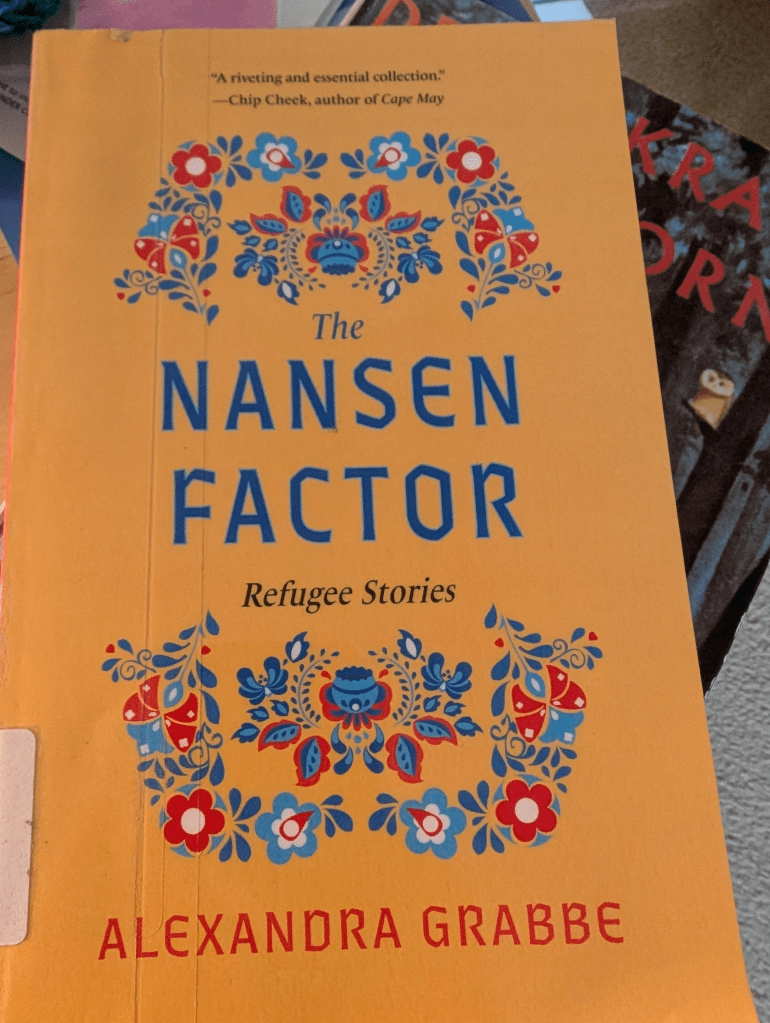
I found this book “The Nansen Factor” at the library and immediately picked it up. First, because the pattern of the flowers on the front reminded me of Sweden. Second, I thought it might refer to Dr. Nansen, the Norwegian sailor who tried to get to the North Pole in 1893 (I was right about this). Third, I thought the author’s last name might be Swedish. Fourth, it said “refugee stories”. So I checked it out and read all the short stories in it.
Now, I think the lady who wrote it means well. I also thought the stories were all well-written. They’re written in this very jigsaw-puzzle-like way. For example, this little girl is wondering if the man is going to reserve separate hotel rooms, or just one. When the man comes back, it doesn’t plainly say he had gotten two different rooms. Instead, it says it in a more backhand way: that he dangles her own hotel key out to her.
It was like every thought in the stories had been super-meticulous crafted together.
But there’s also some things that I didn’t like:
- First, the refugees in this story are all rich Russians that were in cahoots with the tsar, but had to flee after the 1917 revolution. Now, it’s been a while since I studied European history. However, I seem to remember the Russian rulers were particularly awful? The refugees in these stories are all woebegone because they’d lost their giant palaces back in St. Petersburg, which had all been taken over by the common peasants. They did, however, manage to flee with bejeweled Faberge eggs. Weren’t all those riches gained through exploitation and oppression in the first place? It was a little hard to be expected to feel sorry for these people. Now, I think reading from their perspective is still valuable: it’s still a strand of humanity to learn about. However, pretty much all the characters in the stories had an inability to consider anyone else’s perspective. They still, generations after the revolution, seemed to think the Earth should revolve around them. One of them goes back to her old palace in Russia, and when no one is sympathetic that she can’t reclaim her title over it, she pouts, “It’s like you think my ancestors were oppressive land owners or something!” I don’t know, either, that the author was being sarcastic towards these characters; seemed like she was sympathetic. But of course — she herself is descended from these rich, refugee Russians! (Ergo, my theory that her name was Swedish was wrong).
- Other major glaring issue with this book: on the very front cover, there’s a blurb from one Chip Cheek, telling us this is a great book to read. Now, who is Chip Cheek? The name seemed familiar to me. But no, it couldn’t be — but oh, yes, it was! Remember the whole Dawn Dorland-Sonya Larson scandal, when a bunch of rich, prissy, connected authors in Boston decided to say, among other things, “Dawn and her one kidney can go and f*** herself”? They said that about a lady who had donated her kidney to save someone’s life. Chip Cheek was among these rich prissy authors. Anything, therefore, that Chip Cheek endorses should be suspect. But it’s not surprising the author has an affinity to him. She herself is descended from rich snobby Russians, of course she like prissy annoying Boston authors.
- There was more than one story in the book when a young woman, or a thirteen-year-old girl in one case, is either raped or molested by a grown man, an older man. But the woman and the girl both are mostly happy it happened.
- Remember how at first I thought her last name was Swedish, then it turned out to be a last name connected with Russian royalty instead? Well, it’s a small world because after all, this lady is married to a Swedish man. Isn’t that funny! So I searched for her name online, because I supposed that she probably lives in Sweden and I wanted to read more about it. I found her blog. She doesn’t actually live in Sweden, but her husband seems to now, and she goes to visit him. I read a couple of her blog posts. Again, I don’t think she actually means to come across the way she’s coming across. But I think her heritage of Russian royalty just has fettered her thoughts, because she says some very *interesting* things. She says other things that are common-sense and wholesome, so I don’t want to be too harsh. But here’s one of her quotes:
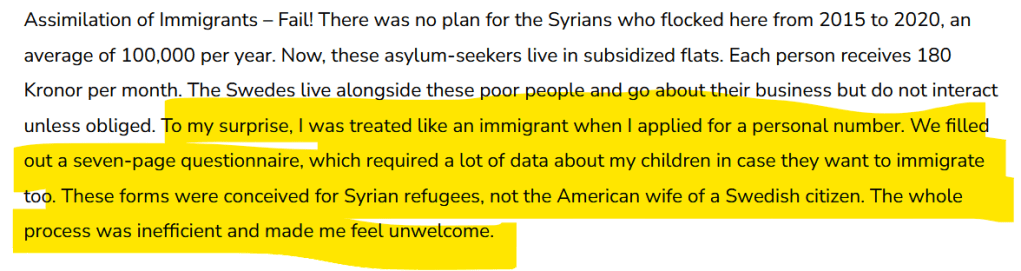
First, I think she in general generalizes a bit, but the highlighted part is quite eye-opening. How dare they!? Don’t they know she’s Russian royalty. How dare she be treated as an immigrant, classed with the uncouth Syrians?! Obviously, questionnaires meant for Syrian riff-raff are dirty rags that she shouldn’t be expected to touch. Why are things so poorly run?
4. Two of the short stories in “The Nansen Factor” either take place in Sweden, or have Swedish characters in them. One of them was called “Shamil”. This author does not like Muslims. Shamil is a genie-type thing that appears and says, “Shariah Law I enforce with fire and sword.” What? Seriously? She’s not totally embarrassed to have written something like that? And the editors, none of them said, hmmm, let’s think again. And Chip Cheek I’m sure just loved it! In the same book, a white lady is sitting in her car. She’s people-watching, and from afar she sees two people walking around, and one of them is wearing a flowered headscarf. These two people are immediately described as “Middle Eastern immigrants.” How does she know? They might have been born right there. Lord. Again, did no one edit this and think, wait a minute. Of course not, because they were working within the confines of the worldview of thwarted, pitied Russian royalty and Chip “kidney donations are a pestilence” Cheek.
So that is what I have to say about this book.

 mejshasan.com
1 thought on “The Nansen Factor”