

I’ve gotten much better at reading both Arabic and Swedish … Arabic after having read the translated versions of the first three Harry Potter books, and Swedish after having read a few old, thick, word-rich Swedish books I found at the Los Angeles Library.
I didn’t notice I was getting that much better, because really the only reason I made it through the Harry Potter books was that I pretty much know them word-for-word in English, and so couldn’t get lost in the Arabic. As for the thick Swedish books I’d read, they were full of fine words I’d never heard of — one after the other — and while I could understand them through context clues, I couldn’t after having read a page recite to you a single one that I’d learned. I couldn’t keep them in my head.
But I’ve been reading these two books now …
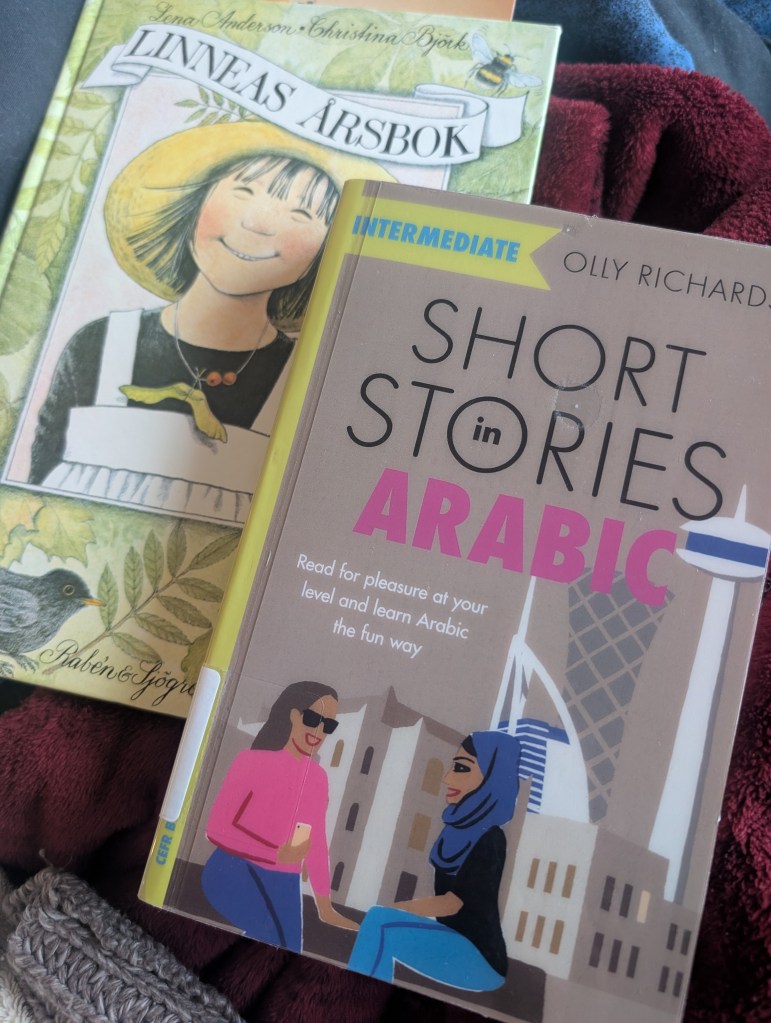
and I’m doing so well!
The book on the left is the Swedish book. It’s just a kids book that translates to Linnea’s Year-Book, BUT … a few years ago I was reading the first page …

… and I was feeling so frustrated. Because I was thinking, this is a simple book! Yet, I was having problems reading just that first page. I worried through it somewhat uncertainly, in disbelief at how much trouble I was having.
But the other day, I picked it up and not only can I read the first page without problems, but I can sort of just glance at it and skim it quickly and get the gist — just the same way I can in English! Woohoo!
Then the Arabic book I found at the library. It’s a really nice book. When I was in college and studied Arabic, we studied the oh so insufferably boring “Al Kitaab” books. Ugh. They were the most boring things you could possibly have thought of, on top of being so confused by everything I was reading and not making heads or tails of it.
But I’m reading these short stories now with no problem at all:
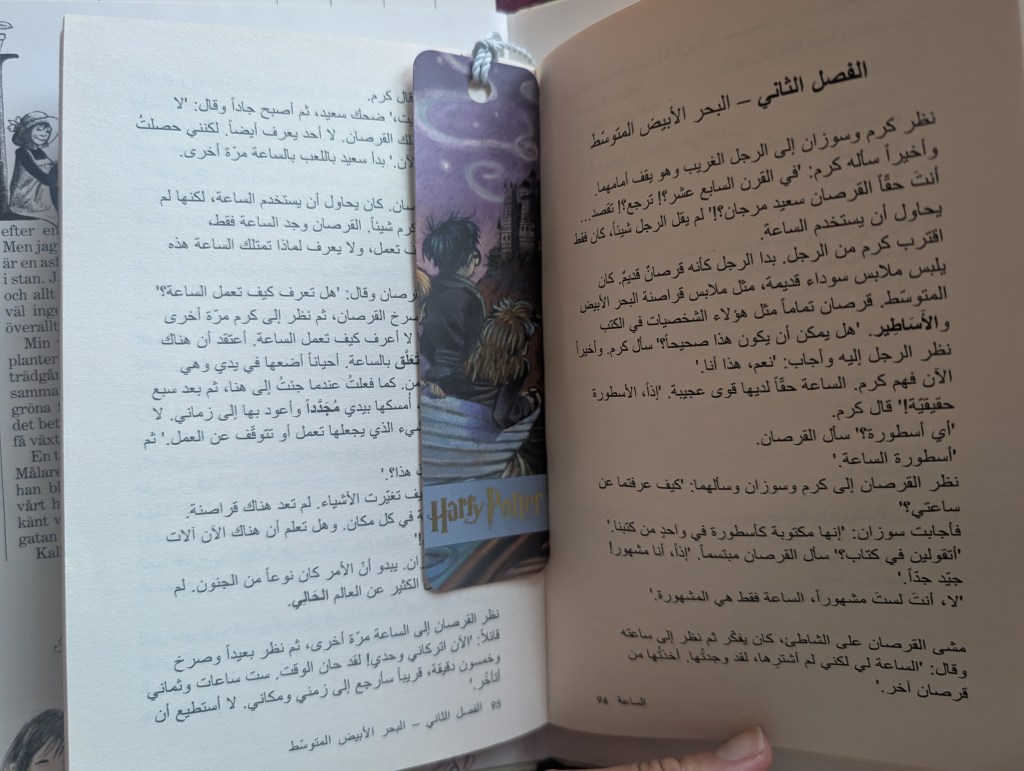
It says these are intermediate level. I can tell you they are much, much simpler than the Harry Potter books. The stories in them are also pretty fun to read. They’re not plodding, moralizing, political tombstones.
Then the other day, I went back to one of my old “Al Kitaab” texts from college, Part Three, and I read an old passage we were assigned back then, by the Professor Fahmy Howaydi of Algeria:
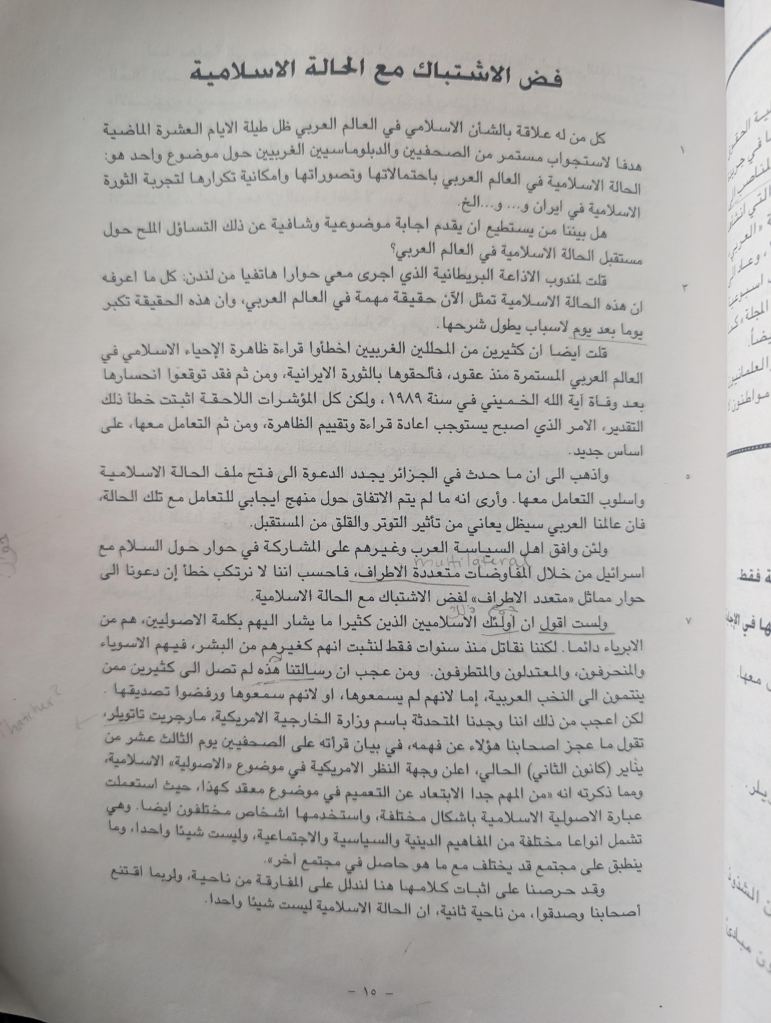
Part of the reason the Al Kitaab books are so boring is because a lot of the topics are political, and of course, not even American politics that you’d be familiar with, but politics from Algeria and Saudi — come on!
Any case, this passage both bored me to tears back then, and also I didn’t have a clue what it was talking about — even after we discussed it in class. You can see my confusion with the arrow I drew in the lower left, pointing at my scribbled note “Thatcher?” See, the article at that point introduces the spokesperson for the US State Department, Margaret Rottweiler. Despite the fact that I knew Margaret Thatcher was a British Prime Minister, I just decided if the article was going to mention a Margaret, it must be Margaret Thatcher. Partly because I read the Arabic transliteration of “Rottweiler” and couldn’t make sense of how to pronounce it. That’s how confused I was. Of course, I’ll bet you anything that Margaret Rottweiler was just as equally nasty as Margaret Thatcher, so maybe it doesn’t matter if you tell them apart or not.
But this time when I read the article, I understood it and was able to follow the meaning quite fluently! I didn’t get lost in complicated sentence structures. I wasn’t struggling to juggle the definitions of multiple unknown words in trying to string the overall meaning together. And I’m much faster at reading Arabic. I can’t skim it like I would with Swedish or English, but still.
I feel like I’ve been trying to get better at these languages for decades with nothing to show for it, but things finally seem to be coming along.

 mejshasan.com