
The entire city of Loserville, I mean, Los Angeles, is a giant trashy dump. So imagine my surprise when I went to the main branch of the library and found it to be a very nice place. Los Angeles putting money and resources into something that you don’t have to be rich to access??? How did this happen??? I feel sure it was through a fluke. They thought they were funding “National Expensive Car Day” or something, and didn’t realize the money was actually meant for the library until it was too late.
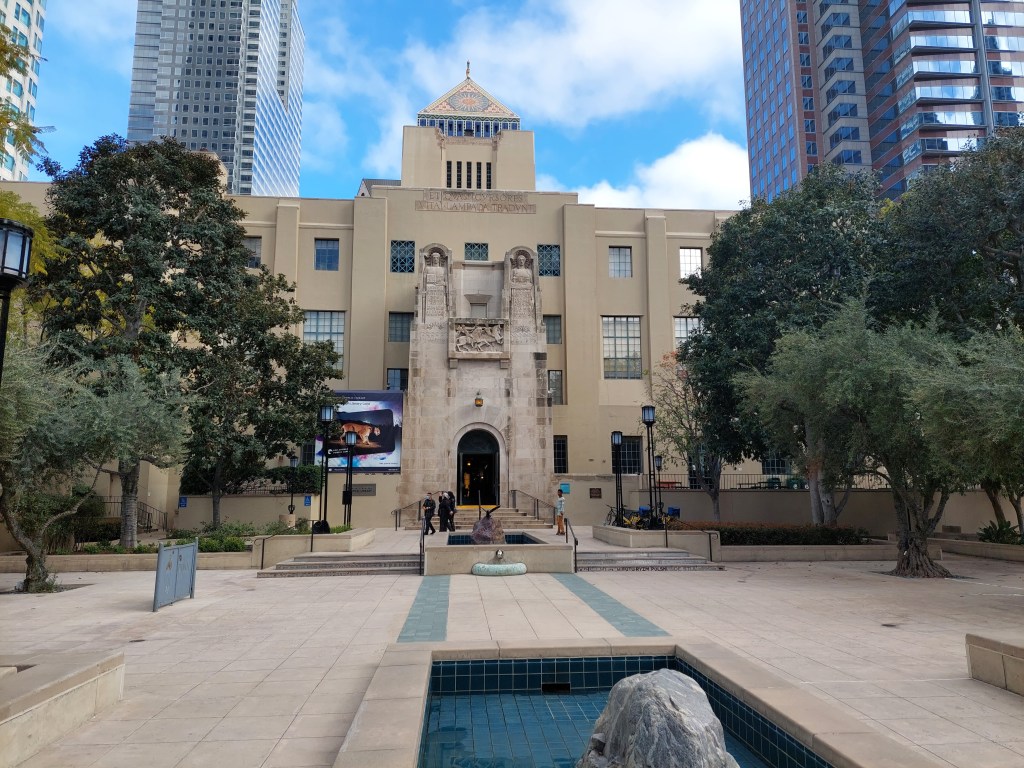
This is what it looks like:

Yes, it’s hard to believe your eyes!! How did something this nice come to exist in the trashy city of Los Angeles? How did it happen?
To be sure, the entire area surrounding the library is full of trash, and men who are trashy, and bad smells, and all the other hallmarks of a place that has destroyed its social fabric and really doesn’t care what happens to anyone who doesn’t have money and doesn’t mind having sunk into the extremes of human degradation and nastiness. That’s Los Angeles in a nutshell.
Any case, the library is somehow standing amidst all of this. It’s got millions of books. So far, I don’t think there’s a book that I wanted that it didn’t have.
They have all five books in the “Face on the milk carton” series — I didn’t even know there were five books in the series, until now.
They have the sequel to “Summer of my German soldier”, which I only found once before, years ago, and I can’t wait to read it again.
Sometimes, you search for a book title, and you get the location code, and you go to that place, and the book isn’t there. When that happens, just go to the librarian and ask them. Chances are, the book isn’t on the public viewing shelves, but in some back storage room. The librarian will go and get it for you. You just have to ask. It’s never clear from the catalog if the book is in back storage or not, so don’t fret if you can’t find it at first.
But I do think it is yet another hallmark of Los Angeles, that the library can’t figure out how to label if a book is on the shelf or in the back storage directly in the catalogue. In the UNC Chapel Hill libraries, there were also books in storage, but you always know as soon as you look the book up, because of course it’s important to know accurately where all the books are located!
The library also has a “makerspace” like what UNC has. I miss that place so much, and have always wanted to find a new one I can access for free. So I thought I was finally in luck with the library’s “Octavia Lab.” Upon further investigation, however, it turns out everything in it is broken down, or something. Maybe that was an exaggeration, but it sure seemed like everything of interest is broken down. Also, it’s only open at spare hours snatched here and there, and the hours are not super convenient if you have to work during the day. Then, when it is open at night, well, you probably don’t want to be out and about in Loserville proper at night, especially if you’re coming on the metro. The metro is already scary enough in broad daylight.
Then, one of the best parts of the library is that it has a spacious room full of international books! It’s got all sorts of languages, like Armenian, Slovenian, Bosnian, like all sorts. Half the books are Spanish, Chinese, and Farsi. But I had eyes only for the Swedish section of course ❤ ❤
Well, I had eyes for the Arabic section as well. Unfortunately, for my first impression, it was entirely boring — several thousand books, and not one looked interesting. They were all old, and they were all like extremely dull-looking. There were some Shakespeare translations, but I don’t even really like reading Shakespeare in English. There were no fun, cute books. Everything seemed ponderous and written by a sighing man. After I had visited this section a few times, though, I found a few books I’d initially overlooked. They have the first three Harry Potter books translated into Arabic. And they have Malala’s book translated into Arabic as well. I guess it’s funny that the Arabic books I want to read are all originally not written in Arabic, but there you go.
My hope, though, is that if I can read the Harry Potter books and then Malala’s book in Arabic, maybe one day I can read the Arabian Nights in the original Arabic. Back in college, we read one of these stories in my Arabic literature class, and it was really hard to read. But maybe one day I can get to that level.

So then, the Swedish section! The Swedish section is sadly not as large as the Arabic one — just four shelves, rather than like 4 or 5 giant entire bookshelves*. I got a little annoyed with the selection. For example, they only have like one or two books by Henning Mankell. I would love to read those books in Swedish, rather than the English translations. And you know what’s super annoying? They have more German translations of Henning Mankell books than they have them in the Swedish originals.
*Note: Although my original impression was that the Swedish section was not that large, they have many more Swedish books in back storage! The problem is, there’s no list anywhere with all the titles. Sadly no way to browse them. So you have to think of Swedish books you’ve heard of and might want to read, and then look them up in the catalogue to see if the library has them, and then you go to the circulation desk and the library sends someone to get you the book from back storage.

And they don’t have any modern Swedish books at all. I don’t think they are actually still maintaining and updating these selections. It’s all old stuff. I came across a book the other day called “The red address book”. It’s by a Swedish author, and recently published. But while you can find the English translation in the library, you cannot find the Swedish original. (Update: I eventually got this book from a library in Sweden, and it’s really bad.) There’s no Fredrik Backman books in Swedish either. (Update: I read one and a half of his books from a library in Sweden, too, and I didn’t really like them, either. But I have read one other of his books in English and I did like that.)
Update: early in 2025, they reorganized the international books room, and ALL the Swedish books were taken off the shelves and sent to back storage 😦 So these shelves I was just talking about no longer exist. But there is one other spot where you can still find Swedish books on the shelves.
I learned recently from an exhibit at the Swedish Museum in Philadelphia that there was a Swedish woman, Fredrika Bremer, who traveled to the US in the 1800s. She was from an upper-class background, never married, and became a writer and traveler. The museum had some excerpts from her USA travel book. I would love to read her original travel book in Swedish*. While they don’t have that at the Los Angeles library, they do have two of her novels in Swedish: Hemmet (The Home) which I read, and Grannarna (The Neighbors). They are not on the shelves, they are in the back storage, so you ask at the circulation desk and they will bring them for you.
*Update: I found her USA travel book at the library during the last time I was in Sweden. At first I thought, oh, it’s just 230 pages, maybe I can knock it out. Well, turns out it was one of like four volumes, so it’s more like 800 pages. It’s all letters she wrote to her sister. I didn’t even knock out the first volume, I still have 30 pages to go. Between you and me, she was trying too hard to be moral to be all that interesting. On the other hand, she was meeting with Emerson and all these famous American writers. That was certainly interesting. And, I found out that she did not just travel to the USA in the mid-1800s, but also to Palestine! They have her travelogue from Palestine at the library in Malmö, Sweden, as well.
Now back to the Los Angeles library and the Swedish books there. There’s this series of books written in the 1950s about a Swedish family from 100 years before. This family is very poor, and their daughter dies of starvation, so they sell their farm, gather up their belongings, and clamber onboard a cramped sailing vessel to come to the US. They have the whole series at the library (but in the back catalogue, so go to the desk to kindly request someone to bring it to you). I just finished reading the first book. It describes this family’s final four years in Sweden, from 1846 to 1850, and then the second half is about their time on the boat. My eyes were opened! I’d never before had to seriously contemplate what it would have been like to immigrate in the 1850s on a sailing vessel, where you needed the wind in order to move. It took them 10 weeks, which they passed with 70-80 people crammed into sleeping quarters the size of the kitchen and family room in a typical modern home. After reading it, I temporarily stopped complaining about long-distance travel in our advanced age.
Now, how about when it comes to kids’ books in Swedish, like Astrid Lindgren and Elsa Beskow and Sven Nordqvist? The great news is, there’s a ton of these in the catalogue. They’re all part of a special collection. But they are not in the international books room. You have to go to the children’s section of the library, rather than the international room, and ask the circulation desk there to get you these books from the back catalogue. And there’s a few right on the shelves in the very book room of the children’s section.
Some more pictures of the library:


 mejshasan.com
7 thoughts on “The central library in Los Angeles”